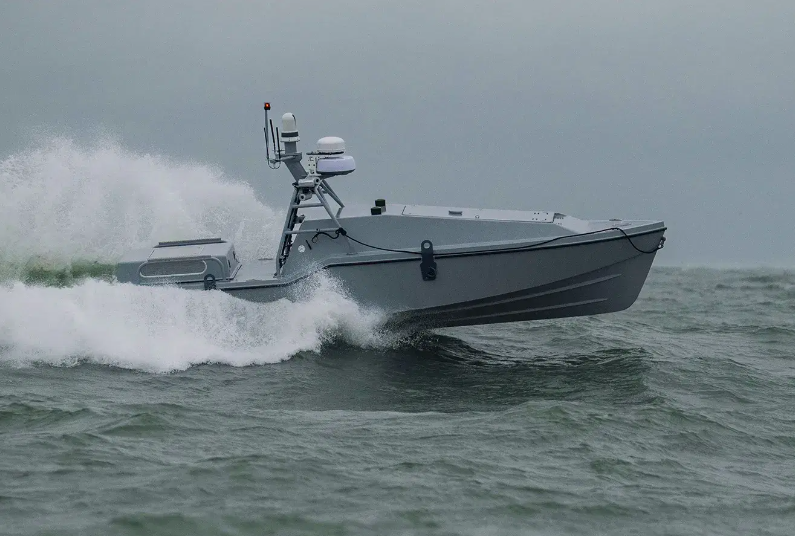
In under 15 months, the Defense Innovation Unit (DIU) and Naval Sea Systems Command (NAVSEA) Program Manager, Ships (PMS) 420 successfully prototyped, validated, and transitioned the Production-Ready, Inexpensive, Maritime Expeditionary (PRIME) Small Unmanned Surface Vehicle (sUSV) program, resulting in a production contract for over 200 next-generation USVs to directly support INDOPACOM.
The Department of the Navy had an urgent operational need for small Unmanned Surface Vehicle (sUSV) interceptors capable of autonomously transiting hundreds of miles through contested waterspace, loitering to monitor for maritime threats, and sprinting to interdict noncooperative, maneuvering vessels.
There was a critical requirement to rapidly deliver a large number of these interceptors on an aggressive timeline in order to support INDOPACOM operations. The urgent need for a massive quantity of interceptors is driven by the CNO's Hedge Strategy, which relies on "unmanned mass" to deter threats in INDOPACOM while reducing risks to crewed vessels. This requirement previously remained unmet because traditional defense acquisition was too slow to rapidly deliver the advanced, multi-agent autonomous technologies that integrated commercial scaling can provide.
DIU and PMS 420 partnered with commercial vendors to rapidly prototype next-generation sUSVs equipped with multi-agent collaboration for adaptive interception, agile software update approaches, and advanced navigation and communication systems for contested environments. By utilizing the Commercial Solutions Opening (CSO) process, the Department of War evaluated multiple commercial solutions. The evaluation process narrowed 116 initial submissions through a rigorous, multi-phased assessment that included initial design reviews, vendor-led prototype demonstrations, and government-led autonomy and performance evaluations.
Ultimately, the selected prototypes were tested extensively by military personnel in real-world military environments, including seakeeping assessments at the Naval Surface Warfare Center Carderock Division and operational integrations during major fleet exercises like UNITAS and Balikatan.
The entire capability transitioned in under 15 months (Area of Interest issued Jan 2024; transitioned May 2025), with validation of production readiness executed in just four months. This delivery speed was 50–70% faster than legacy acquisition approaches, which previously took more than six years (Feb 2018 to Oct 2024) to move from prototype testing to production deliveries.
The new sUSV interceptors were produced at scale at a cost per platform comparable to earlier iterations, despite vastly improved capabilities that significantly exceeded contractual baseline requirements.Deploying these interceptors at scale reduces the risk to manned naval forces and alleviates their tasking burden, and these deployed interceptors are operating well above baseline expectations. In June 2026, a Saronic vessel, part of the DIU program, rescued soldiers from a downed helicopter in the Strait of Hormuz. It was the first documented use of an autonomous maritime vehicle in a personnel rescue.
Of the 200+ units ordered, 66 were successfully fielded in 2025 under a contract ceiling of $392.4 million. The remaining units are following a phased, continuous delivery schedule, as the commercial production line scales to its target rate of 10 or more new vehicles delivered per month (120+ annually).